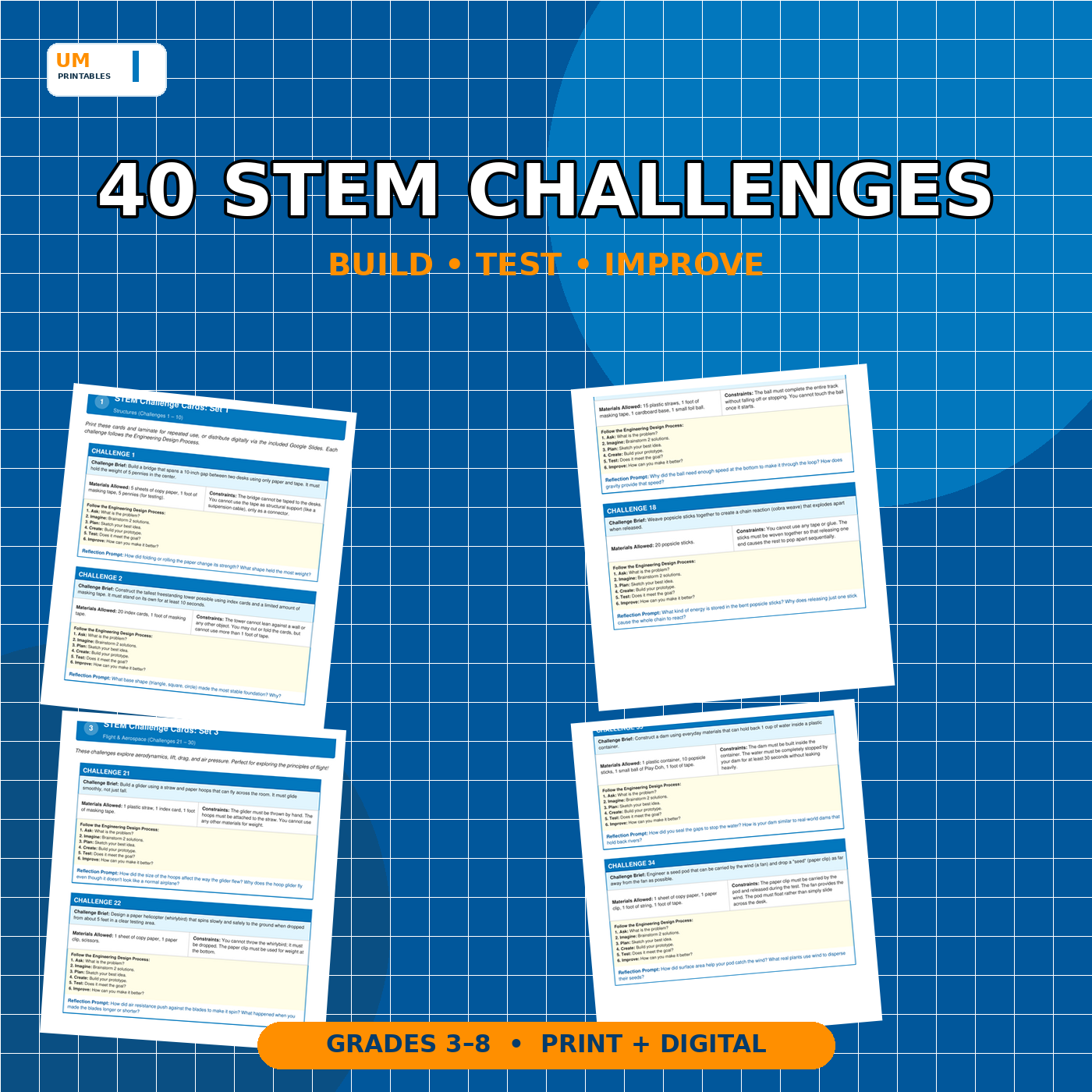
STEM Challenge Card Deck | 40 Low-Cost Engineering Activities | Grades 3-8
Secure Razorpay checkout · Instant download · No refunds (digital product)
You'll be asked to sign in first
Quick overview
The **STEM Challenge Card Deck** is a ready-to-use collection of **40 hands-on STEM and engineering challenges for Grades 3–8** that gives students opportunities to design, build, test, evaluate, and improve solutions using simple classroom materials.
Organized around **Structures, Forces & Motion, Flight & Aerospace, and Nature & Energy**, the challenges develop **engineering design, problem-solving, creativity, critical thinking, collaboration, and scientific reasoning** while keeping students actively engaged.
Each challenge guides learners through an iterative **Engineering Design Process**, with clear problems, materials, constraints, planning, testing, and reflection. The format makes the activities useful for **STEM centers, enrichment, early finishers, maker activities, Friday STEM challenges, science lessons, small-group learning, and substitute plans**.
Product description
STEM Challenge Card Deck | 40 Hands-On Engineering Challenges | Grades 3–8
Bring hands-on STEM, engineering, critical thinking, creativity, and problem-solving into your classroom with this ready-to-use STEM Challenge Card Deck for Grades 3–8!
This resource includes 40 low-cost engineering challenges built around the Engineering Design Process (EDP), giving students repeated opportunities to Ask, Imagine, Plan, Create, Test, and Improve while working with accessible classroom materials.
Perfect for STEM centers, science stations, engineering lessons, makerspace activities, Friday STEM, early finishers, enrichment, small-group work, sub plans, and year-round STEM instruction.
Students don't just build a product—they learn to define a problem, work within constraints, test ideas, analyze results, and improve their designs.
✨ WHY TEACHERS LOVE THIS STEM CHALLENGE DECK
• 40 Hands-On Engineering Challenges A full collection of engaging STEM activities organized into four focused challenge sets: Structures, Forces & Motion, Flight & Aerospace, and Nature & Energy.
• Low-Cost & Classroom-Friendly Challenges rely primarily on familiar materials such as paper, masking tape, straws, index cards, cardboard, popsicle sticks, cups, string, rubber bands, aluminum foil, pipe cleaners, toothpicks, and Play-Doh/clay, with some activities using simple teacher-provided testing materials.
• Print + Digital Use Use the print-ready challenge cards for classroom stations, teams, centers, or small-group instruction, and use the accompanying Google Slides digital version for paperless, 1:1, or remote learning environments.
• Student-Centered Learning Every challenge gives students a clear problem, materials, constraints, engineering steps, and a reflection prompt so students can take greater ownership of the design process.
• Process Over Product Students learn that an unsuccessful prototype is not the end of the process. Testing produces information that can be used to redesign and improve the next version.
📋 WHAT'S INCLUDED 1. Teacher Tips & Facilitation Guide
A practical guide for implementing the STEM challenges successfully, including:
• How to introduce and facilitate challenges • STEM Bar material-management strategies • Pre-packaged material ideas • Grouping and classroom-routine suggestions • Managing material limits and constraints • Process-focused assessment guidance • Google Slides implementation guidance • Classroom safety reminders for testing activities
2. Materials Reference List
A convenient core materials reference covering the supplies used most frequently across the 40 challenges, along with quantity guidance and low-cost sourcing ideas.
3. Engineering Design Process Classroom Poster
A classroom-ready visual reference for the six-step process used throughout the deck:
ASK → IMAGINE → PLAN → CREATE → TEST → IMPROVE
4. Student Reflection Journal
A reusable planning and reflection tool with space for:
• Challenge goal • Success criteria • Sketch and material planning • What worked • What failed or needs improvement • What students would change in another trial
5. 40 STEM Challenge Cards
Each challenge includes:
• Challenge Brief — the engineering problem to solve • Materials Allowed — specific materials and limits • Constraints — rules and design requirements • Engineering Design Process — six guided steps • Reflection Prompt — connects the activity to STEM concepts and engineering thinking
📦 THE 40 CHALLENGES ARE ORGANIZED INTO 4 SETS SET 1: STRUCTURES — CHALLENGES 1–10
Focus: Stability, strength, balance, load distribution, geometry, and structural design.
Students explore challenges such as:
Paper Bridge • Index Card Tower • Straw House • Cup Tower • Catapult • Foil Boat • Cardboard Chair • Toothpick/Play-Doh Dome • Pipe Cleaner Tower • Leaning Tower
SET 2: FORCES & MOTION — CHALLENGES 11–20
Focus: Force, motion, gravity, friction, energy transfer, timing, and mechanical systems.
Challenges include concepts such as:
Zip-Line Design • Balloon-Powered Vehicle • Rubber-Band Racer • Pendulum • Rolling/Moving Designs • Wind-Powered Vehicle • Pulley Systems • Motion and Timing Challenges
SET 3: FLIGHT & AEROSPACE — CHALLENGES 21–30
Focus: Flight, air resistance, stability, lift, drag, pressure, and aerospace engineering.
Students investigate designs including:
Hoop Glider • Whirlybird • Parachute • Straw Rocket • Ring-Wing Aircraft • Air-Powered Flight Challenges • Lander Designs • Drop-Test Engineering
SET 4: NATURE & ENERGY — CHALLENGES 31–40
Focus: Energy transfer, environmental engineering, renewable-energy ideas, structure and function, and biomimicry.
Challenges include:
Solar Oven • Wind Turbine • Water Dam • Seed Dispersal Pod • Insulated Cup • String Telephone • Water Wheel • Energy Transfer • Nature-Inspired Engineering
🎯 ENGINEERING DESIGN & NGSS CONNECTIONS
The challenges provide opportunities to practice the engineering-design concepts represented by:
3-5-ETS1-1 — Defining problems with criteria and constraints 3-5-ETS1-2 — Generating and comparing possible solutions 3-5-ETS1-3 — Planning and conducting fair tests
MS-ETS1-1 — Defining design problems precisely MS-ETS1-2 — Evaluating competing design solutions MS-ETS1-3 — Analyzing test data MS-ETS1-4 — Developing and using models for iterative testing and optimization
🎓 GRADE LEVELS
Grades 3, 4, 5, 6, 7, 8
The challenge deck can be adapted by adjusting teacher support, vocabulary, group structure, testing expectations, data collection, written explanations, and the level of student independence.
📚 SUBJECTS
Science • STEM • Engineering • Technology • Critical Thinking • Problem Solving
⏱️ GREAT FOR
STEM Centers • Engineering Stations • Science Enrichment • Friday STEM • Makerspace • Early Finishers • Sub Plans • Small Groups • Team Challenges • Science Classes • STEM Rotation • Year-Round STEM Activities
⭐ BUILD. TEST. IMPROVE.
Give students repeated opportunities to think like engineers, work within real constraints, test their ideas, learn from unexpected results, and improve their designs.
40 challenges. One complete Engineering Design Process. Endless opportunities to build, test, think, and improve.
Frequently Asked Questions
What's included in this resource?
This resource includes: Teacher Tips & Facilitation Guide • How to set up a "STEM Bar" for easy material management • Grouping strategies and grading advice (focusing on the process over the final product) • Instructions for assigning the digital Google Slides version; Master Materials Reference List • A complete checklist of everyday materials needed for all 40 challenges • Low-cost sourcing suggestions (dollar stores, recycling bins); Engineering Design Process (EDP) Classroom Poster • A colorful, visual reference poster detailing the 6 steps: Ask, Imagine, Plan, Create, Test, Improve; Student Reflection Journal • Pre-challenge planning page (goal setting and sketching) • Post-challenge reflection page (analyzing what worked, what failed, and how to improve). The complete resource contains 31 pages.
Who is this resource perfect for?
This resource is perfect for: STEM centers, early finishers, sub plans, or Friday STEM challenges!.
Is this a hands-on activity?
Yes, this resource includes hands-on activities that engage students through physical manipulation and discovery-based learning. Students learn by doing, not just by completing worksheets.