IEP Data Collection: The Special Education Teacher's Complete Guide
IEP data collection doesn't have to be overwhelming. This guide covers the three main data collection methods, when to use each, and how to make it sustainable.
If you're a special education teacher, IEP data collection is probably the most time-consuming part of your job. Between progress monitoring, behavior tracking, and parent communication, it can feel like you spend more time collecting data than teaching students. But data collection doesn't have to be overwhelming. With the right systems in place, you can collect meaningful data efficiently — and actually use it to drive your instruction. This guide covers the three main IEP data collection methods, when to use each, and how to build sustainable data systems.
Why IEP data collection matters
IEP data collection serves three critical purposes: (1) It documents student progress toward IEP goals — required by law under IDEA. (2) It informs your instruction — if a student isn't making progress, the data tells you when to adjust your approach. (3) It supports IEP team decisions — when it's time to update goals, change placements, or conduct an FBA (Functional Behavior Assessment), your data is the evidence. Without good data, you're making decisions based on gut feelings. With good data, you're making decisions based on objective evidence.
The three main IEP data collection methods
1. Frequency (Event) Recording
Frequency recording counts how many times a behavior occurs in a given time period. You simply make a tally mark every time the behavior happens. Best for: behaviors that have a clear beginning and end, happen at a manageable rate (not too fast), and are discrete (you can count each instance). Examples: calling out in class, hand-raising, leaving seat, instances of aggression.
Example IEP goal: 'Student will raise hand before speaking in 4 out of 5 opportunities.' Data: Tally each hand-raise and each call-out. Calculate the percentage.
2. Duration Recording
Duration recording measures how long a behavior lasts. You start a timer when the behavior begins and stop it when the behavior ends. Best for: behaviors that vary in length, behaviors where the duration is the issue (not the frequency), and sustained behaviors. Examples: tantrums, off-task behavior, work completion time, time spent in calm-down corner.
Example IEP goal: 'Student will remain on-task for 10 consecutive minutes during independent work.' Data: Time how long the student stays on-task before getting distracted.
3. ABC (Antecedent-Behavior-Consequence) Recording
ABC recording is a descriptive method where you note what happened BEFORE the behavior (antecedent), the behavior itself, and what happened AFTER (consequence). Best for: behaviors where you need to understand the function (why is the student doing this?), new behaviors you're still analyzing, and FBA data collection. Examples: elopement, aggression, property destruction, self-injury.
How to choose the right data collection method
The method you choose depends on the IEP goal and the behavior being tracked. Here's a quick decision guide:
- If the goal is about HOW OFTEN a behavior happens → use frequency recording
- If the goal is about HOW LONG a behavior lasts → use duration recording
- If the goal is about WHY a behavior happens → use ABC recording
- If the goal is about WORK COMPLETION → use trial-based recording (correct/incorrect)
- If the goal is about ACADEMIC SKILLS → use permanent product (collecting and grading the work)
Building sustainable data systems
The biggest complaint we hear from special educators is that data collection is unsustainable. Here are the systems that actually work:
- Use clipboard data sheets — Keep a clipboard for each student with their weekly data sheet. Clipboards travel with you and are always accessible.
- Train paraprofessionals — You can't collect all the data yourself. Train your paras on each student's data sheet so they can collect data during their instructional time.
- Schedule data collection — Build 5-minute data blocks into your daily schedule. Don't try to collect data while teaching — it doesn't work.
- Use operational definitions — Every data sheet should have a clear, observable definition of the behavior so any adult in the room collects it the same way.
- Weekly data review — Spend 15 minutes every Friday reviewing the week's data. Look for patterns, celebrate progress, and flag concerns.
IEP data collection resources
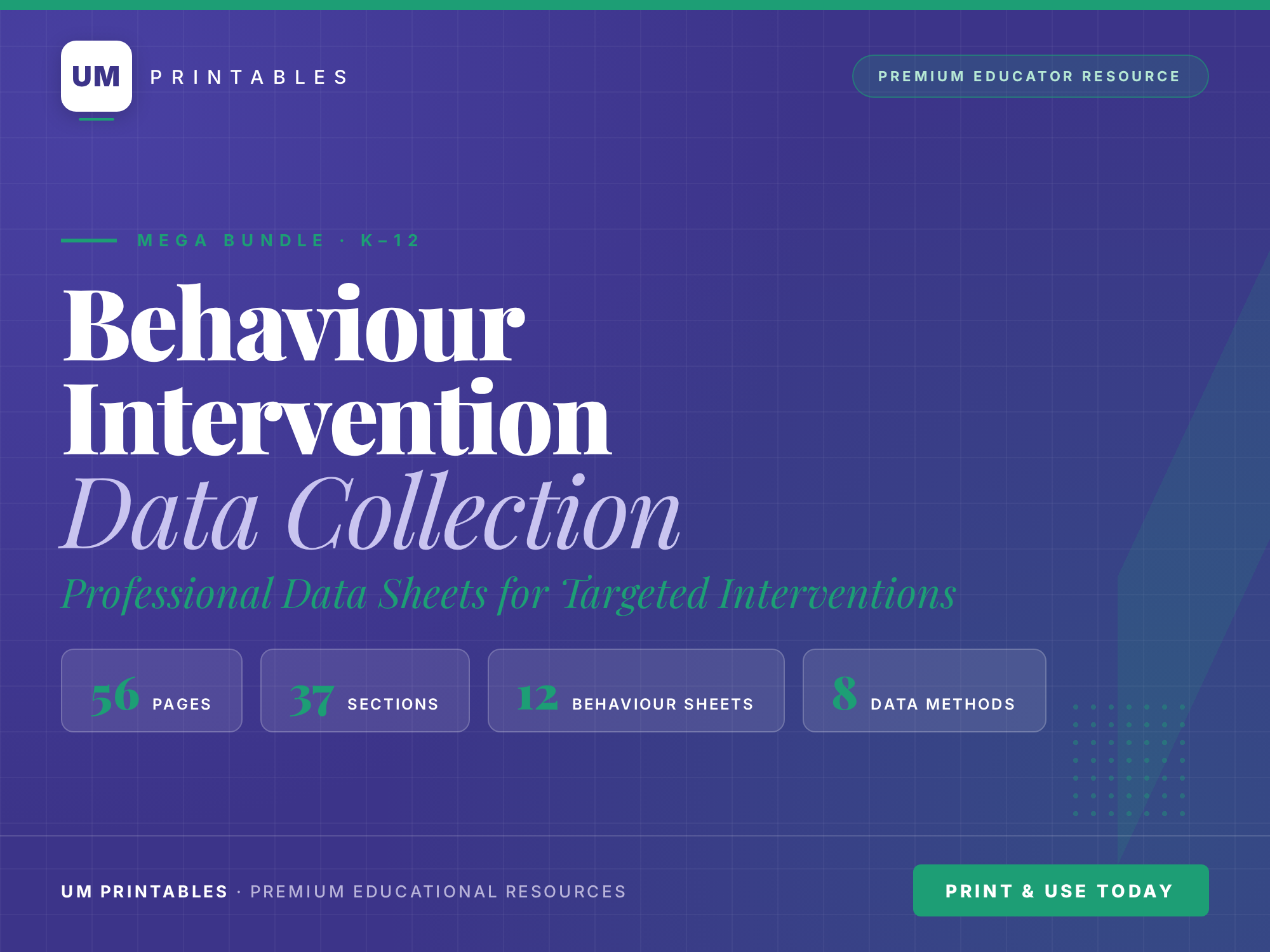
If you want ready-to-use IEP data collection sheets, our Behaviour Intervention Data Collection Bundle includes frequency and duration recording sheets for the 10 most common classroom behaviors, ABC observation forms, a weekly behavior graph template, an intervention planning template, and a home-school communication log. Each sheet includes an 'operational definition' box to ensure consistency among staff.
Get the IEP data collection bundle →
Free IEP data collection sheets
Want to try our data sheets before buying? We offer free IEP data collection samples including a frequency recording sheet, a duration recording sheet, and an ABC observation form. Perfect for evaluating whether our format works for your classroom.
Download free IEP data collection sheets →
Frequently Asked Questions
How often should I collect IEP data?
Most IEP goals require data collection at least weekly. For intensive interventions (Tier 3, behavior plans), daily data is often necessary. Work with your IEP team to determine the right frequency for each goal.
What's the difference between IEP data and progress monitoring?
IEP data tracks progress toward IEP goals (individualized, often behavioral or functional). Progress monitoring typically refers to academic assessments (like DIBELS or curriculum-based measures) that track grade-level skills. Both are required for comprehensive IEP documentation.
Do I need to collect data on every IEP goal every day?
No! That's unsustainable. Create a data collection schedule where you rotate through goals. For example: Goals 1-3 on Monday/Wednesday, Goals 4-6 on Tuesday/Thursday, all goals on Friday for a weekly check-in.
How long do I need to keep IEP data records?
IDEA requires schools to maintain special education records for at least 5 years after the student leaves the district. Check with your district's special education director for specific retention policies.