Classroom Management Strategies That Actually Work (2025 Guide)
Tired of classroom management advice that doesn't work? Here are evidence-based strategies that actually work, plus free printable tools to implement them.
Classroom management is the #1 reason teachers leave the profession. But most classroom management advice focuses on surface-level tricks (clap patterns, call-backs, behavior charts) without addressing the underlying systems that create a well-managed classroom. This guide covers evidence-based strategies that actually work — and links to the tools you need to implement them.
1. Build relationships first
Research consistently shows that positive teacher-student relationships are the strongest predictor of good classroom behavior. Students behave better for teachers they trust and respect. Spend the first two weeks of school building relationships — not teaching content. Learn names, interests, strengths, and challenges. Greet every student by name at the door every day.
2. Teach and practice procedures
Most behavior problems are actually procedure problems. If students don't know how to transition, line up, turn in work, or ask for help, they'll create chaos — not because they're defiant, but because they're uncertain. Teach every procedure explicitly, practice it multiple times, and reteach when it breaks down.
Our Classroom Procedures & Expectations Starter Pack includes anchor charts, procedure cards, and teaching scripts for the 20 most important classroom procedures.
Get the procedures starter pack →
3. Implement restorative practices
Restorative justice shifts the focus from punishment to repair. Instead of 'What rule did you break?' the question becomes 'Who was harmed and how do we make it right?' Restorative practices build community, reduce repeat offenses, and teach students accountability.
Our Restorative Justice Classroom Practices Pack includes affective statements, restorative questions, circle prompts, and repair-of-harm agreements.
Get the restorative practices pack →
4. Create a calm-down corner
A calm-down corner gives students a proactive space to self-regulate before emotions escalate into behavior. When set up correctly (with feeling posters, coping strategy cards, and a calm-down plan), it's one of the most effective proactive classroom management tools.
Our Calm-Down Corner Complete Setup Kit includes everything you need: 5 feeling posters, 20 coping strategy cards, 6 breathing exercise cards, a calm-down plan template, and a parent take-home letter.
Get the calm-down corner kit →
5. Teach self-monitoring
Self-monitoring shifts the responsibility for behavior from the teacher to the student. Students learn to observe, record, and reflect on their own behavior. This builds intrinsic motivation, metacognition, and lifelong self-regulation skills.
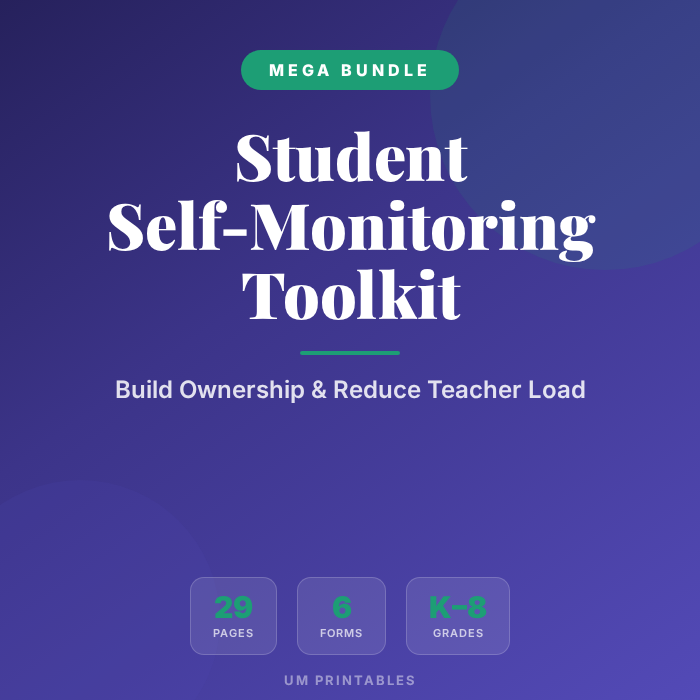
Our Student Self-Monitoring Behavior Toolkit includes weekly goal cards, daily behavior rating scales, and three differentiated self-monitoring forms.
Get the self-monitoring toolkit →
6. Use data, not gut feelings
Track behavior data the same way you track academic data. Our free Daily Behavior Log helps you identify patterns (time of day, triggers, frequency) that inform your intervention decisions.
Download free behavior log →
Frequently Asked Questions
What is the most effective classroom management strategy?
Research consistently shows that building positive relationships with students is the most effective classroom management strategy. Other high-impact strategies include explicitly teaching procedures, using restorative practices, and implementing proactive tools like calm-down corners.
How does PBIS relate to classroom management?
PBIS (Positive Behavior Interventions and Supports) is a framework for school-wide behavior management. It provides Tier 1 (universal), Tier 2 (targeted), and Tier 3 (intensive) supports. Classroom management strategies like calm-down corners and self-monitoring fit into Tier 1.
What is restorative justice in the classroom?
Restorative justice is an approach to discipline that focuses on repairing harm rather than punishing rule-breaking. It uses affective statements, restorative questions, and circles to build community and address conflict.
How do I set up a calm-down corner?
Choose a quiet corner, add soft seating, post feeling identification posters, provide coping strategy cards and breathing exercise cards, include a calm-down plan reflection template, and explicitly teach students how to use it. Our Calm-Down Corner Kit includes all of these materials.